Historic California Posts, Camps,
Stations and Airfields
Fort Winfield Scott: Battery Lowell
Chamberlin
Aerial photograph
of Battery Lowell Chamberlin circa 1938. Click image to view
in a higher resolution. (Coast Defense Study Group National Archives
Collection)
Built in 1904 and mounting four M1903
6 inch guns on M1903 Dissapearing Carriages, this battery is
the centerpiece of the Golden Gate National Recreation Area's
program to interpert the history of the Harbor Defenses of San
Francisco. The small museum in one of the magazines is being
expanded and improved.
The battery, which was the last fortification
to be constructed at Fort Winfield Scott, was named in honor
of Captain Lowell A. Chamberlin, a Civil War veteran who died
in 1899.
Battery Chamberlin's guns were removed
for service in France in 1918 . They were replaced in 1920s with
two 6" M1900 guns on M1900 pedestal mounts in emplacements
2 and 3. These guns could fire serveral rounds per minute and
were used to defend the entrance of the harbor against small
craft and later to protect the defensive minefield from mine
sweepers. These were removed and scrapped in 1948.
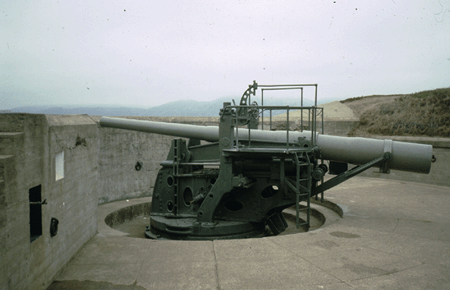
In 1976, the National Park Service replaced
one 6" M1905 gun (Number 9, Watervliet Arsenal) mounted
in a working M1903 (Number 2, Watertown Arsenal) disappearing
carriage that was donated by the Smithsonian. This gun originally
came from Battery Livingston, Fort Hamilton, Harbor Defenses
of New York. The two guns from that battery were re-emplaced
in Battery Schofield at the United States Military Academy at
West Point, New York for some time before given to the Smithsonian.
The other gun is now located at Battery Cooper, Fort Pickens,
Penascola, Florida.
How does
a Disappearing Gun Disappear?
When a lever is pulled, a lead counterweight
drops and the aimed barrel rises to the firing position. After
the gun is fired, its recoil drops the gun below the parapet.
This feature made the gun invisible to enemy ships and protected
the crew during loading. But, while it was an effective weapon
against ships, it had no protection from what its designer could
not have foreseen, the airplane. Batteries designed after World
War I were casemated, providing their crews a large degree of
overhead protection. Below are some rare color photographs showing
the battery's gun in action.
Battery Chamberlin's
Number 3 gun being fired prior to it's removal in 1918. Image
courtesy of Chuck Woffard
Battery Lowell
Chamberlin
by Chuck Wofford
Ordnance
This battery was initially armed with
four 6-inch rapid fire guns, Model 1903 numbers 26,27,28, and
52 manufactured by Watervliet Arsenal, and were shipped to this
battery 14 November 1905, they were dismounted in 15 September
1917, and then were shipped back to Fort Monroe 28 January 1918
(presumably for use in World War I in France) then this battery
sat empty of guns and carriages for nearly 3 years until 1920
(Form 7 shows December1918). After 1919 the carriages were scrapped,
the guns went into storage at Aberdeen Proving Ground, but in
World War II, three of them (numbers 28,29, and 52) were had
some modification included changes to the rifling.
In 1920 two Model 1900's were mounted
in Emplacements #2 and #3 that had been modified to receive the
two 6-inch guns. Serial number 21, was shipped to Slocum, then
9 November 1905 to Fort Taylor, it's home battery was Battery
DeKalb, 2nd place was Fort Winfield Scott. Serial number 31 was
also from Battery DeKalb. The 1928 and 1944 inventories show
that they they were emplaced at Battery Chamberlain. This battery
saw service (4 guns) 1904-1917 and (2 guns) 1920-1948. In 1976
the National Park Service mounted a Model 1905 #9--6-inch gun
in emplacement # 4. Today this is one of the few guns of this
era, that can still be seen, the rest were cut up for the war
and scrap after the war, very few were left.
Ammunition Service
As to ammunition storage and service,
this battery, had a Shell Room and a Powder Room. The movement
of ammunition must be very rapid and it is the duty of the Engineer
Department to so design the emplacement so that each and every
step of the ammunition service may be performed with such speed
that the ammunition can be carried to the breech of the gun at
least as rapidly as it can be loaded into the gun and fired;
and so the rate of fire which can be obtained from the gun be
limited by consideration other that the functioning of the portion
of the ammunition service for which the Engineer Department is
responsible.
The means, which must be provided for
moving ammunition, depend of course upon the weight and bulk
of the piece to be moved. The projectile are stored in rows along
the wall of the shell room, with their point to the wall so that
the bases could be gotten at for placing fuses, the bottom layer
of shells where placed in pairs and put on timber skids, and
then stacked using the same method., there were trolley rails
in this battery, so it was fastened to the ceilings over the
center of gravity of the shells in each row, after 1908 this
was changed, and the larger shells were stacked in two rows down
the middle of the shell room, therefore there was a passageway
between the walls and between the rows.
As far as Powder Service, the powder was
shipped to the battery in metal cases and stored in racks, that
they were shipped in, in most cases, there ends projecting into
the passageway. When a cartridge was desired the solder strip
was to be pulled of without moving the cartridge case from the
rack, this loosens the top of the case and the cartridge is then
pulled out, leaving the case still fastened in it proper place.
The ammunition supply for this battery was stored in the shell
room which was 12 x 38 (there were 2 of them) and held 304 in
each room, The size of the powder magazine was 14' 3" x
36 and held 118. The battle allowance for this battery was 600,
and it's war reserve was 600 both stored at the battery, and
200 H.E, were at the Central Reserve, Larger amounts could be
put in the shell and power rooms, by stacking higher.
Construction
As with any battery is to be built in
any Engineer district, as much information as may be necessary
is sent to the district officer. The first step is to grade and
clear the site, so that the excavation may be started. Construction
started on this battery in June 1902; at the completion of the
excavation, they had removed over 56,000 cu. yds. of dirt and
sand, Construction was suspended, until new plans for the battery
were approved.
The plans were eventually accepted, and
the work on installing the forms was started, on the timber used
in making the forms, in all cases dressed lumber will be used.
As the forms were finished the iron and steel, in the form of
I beams for reinforcing ceilings, and in columns for supporting
ceilings, for reinforcing concrete, they used deformed steel.
There was over 12,352 lb. of reinforcement used in this battery.
As the gun blocks were being poured, the
foundation, were started, there was poured over 11,000 cu. yds.
of concrete as well as 18,650 cu. yds. of finished concrete.
This battery was 350' across the front
of the battery, 30 ' deep and 125' between the guns., beside
the Shot and Power Rooms, it also had a Spare Room 18' X 28'-6",
a Plotting Room 13' X 18' which were located between emplacement
# 2 and # 3 of this two story battery, an Oil Room, 10, X 20-6"
and a Guard Room 10' X 20"-6", and two Store Rooms
10' X 8'. these room were between emplacement #1 and # 2 also
on the other end of the battery was and Oil and Tool Room10'
X 20'-6" and a power room 10' X 20'-6" and the Generator
Room that was 10' X 20'-6", with a Latrine for Officers
and Enlisted 25' behind Emplacement # 1, also there was a B.C.
over the top of the rooms between emplacement #1 and 2 and Emplacement
#3 and 4' The last thing to do was to add sand on the front and
flanks of the lower floor of batteries, the sand was filled in
front of the concrete,(Horizontal protection, front of magazine,
15 feet of concrete, 45 feet of sand; equivalent to 30 feet of
concrete. Horizontal protection front of gun, 15 feet of concrete,
40 feet of sand; equivalent to about 28 1/2 feet of concrete
- Vertical cover over magazine, 10 feet of concrete) then when
a shell was fired at the battery it has been found that a projectile
entering a mass of sand appears to have a tendency to deflect
upward and to leave the sand with out penetrating very far, there
was over 19.000 cu. yds. of fill used.
The exception is the blast apron, which
is made of concrete, and immediately in front of the gun, they
had to be laid very carefully. When the structure was completed
the district Engineer officer prepares the so called "transfer
drawing" then the Engineer officer and the local Coast Artillery
officer , make an inspection of the structure , and all was in
order and the keys, were transferred to the Artillery commander.
This battery was transferred on December
27, 1904 at a cost of $100,803.45, and by March 1, 1904, Battery
Chamberlain was reported to be ready for it guns to be mounted,
which had not yet arrived.
Power
This battery was electrified around December
of 1903, and it used 6.5 for Battery Chamberlain, B/11, F/5,
F/6, F/7, P/5, Fiv/1, Biv/1, one 25 kw, set was to be installed
in the engine room, the feeders and branch feeders, were centered
at a cabinet panel in the emplacement plant switchboard. Prior
to December of 1904 a few small electrical plants has been installed
in some of the batteries at Fort Winfield Scott, but after analyzing
the needs of the area, the board concluded that a central power
station was needed for each of the Forts, but with the shortage
of funds, it was decided to put the first one at Fort Winfield
Scott.
Fire Control
Traverse in Azimuth emplacement one, left
was 36 and right was 190, emplacement # two-left was 36 and right
was 190 ( this was after the four were taken out and the two
were remounted).
The B.C.-B1 was a standard concrete station
located on the left flank of the battery at an elevation of 54
feet. An azimuth instrument Model 1910 and a Swassey D.P.F.,
all type A11. were available. B2S2 was a single dug in station
at Fort Point at an elevation of 134 ft. The length of the base
line from BC B1 to B2S2 was 5400 yards. Spotting was provided
for stations BC-B1 and B2S2. The plotting room was in the battery
itself, and was equipped with a Model 1904 Whistler-Hearn plotting
boards. However, a 110 o Model 1915 plotting board was required,
and Point Bonita at an elevation of 233 feet was a single dug
in.
Miscellaneous
In a letter dated Jul 6 1908, from Major
Charles McKinstry, stated that a road was to be built, from Lobos
Creek supply road with a road branching into this battery, in
front of the battery on the beach 60 ft from the front of the
battery, thence through the sand dunes in the rear of range finding
station to the pumping.
Abandonment
Declared surplus by a classified letter
in 1947 (Reference HQ AGF 602-1/109 (C) May 23 1947 GNGOS-1A
May 23 1948 Subject: Harbor Defense Installations to of Z1 Armies.
Dismantling and removal of guns directed by 2nd Ind HQ Sixth
Army September 2 1948 to Ltr Ch of Ord May 28 1948. Subject:
"Ordnance equipment excess to the needs of the H.D.S.F.
to CG AGF.) these two weapons remained in service until after
World War II. Harbor Defense Project (HDSF-AN-45) called for
retention of this battery. Today this battery is in excellent
condition. The Park Ranger, in period uniforms at the 6-inch
gun once a month, gives demonstrations in a gun drill. This battery
is historically significant because, it was the only coastal
battery in the Presidio to have survived in post World War II
days and emplacement number 4 today contains the only Endicott
period gun presently at San Francisco Bay.
Report of
Completed Works - Seacoast Fortifications
Newscopy:
"At the instant an alert sounds vigilant artillerymen leap
to their positions, draw back part of the clever camouflage and
prepare a big six-inch gun for hurling shells - if it should
ever be necessary - to guard San Francisco's coast line. That
is the swift action you see above...". 8 September 1942.
Photograph courtesy of the San Francisco Public Library
Battery Chamberlin
Today
Battery Chamberlin's
Emplacement
4 with the 6" rifle
today. Photo courtesy of Mark Berhow.
Prior to
the Army turning Battery Chamberlin over to the National Park
Service, the Presdio used it as a NBC (Nuclear, Biological and
Chemical) defense training center. The room on the left was used
for CS agents, while the one on the right was used for CN. October
2000
Emplacement
2 modified for the M1900 barbette mounted rifle. October 2000