Historic California
Posts, Camps, Stations and Airfields
The Fort at Fort
Point
(including East
and West Batteries, Battery Fort Point)
Fort Point
by Colonel Herbert M.
Hart, USMC (Retired)
The situation truly was
well in hand when John
Fremont, a few Marines,
and some settlers made an amphibious assault on the Golden Gate
back in 1846. It was midnight on July 1, when the small party
crossed from Sausalito in a launch, scaled the 100-foot height,
and swarmed into the adobe fort of Castillo de San Joaquin.
Ten cannon quickly were
spiked and the attacking party waded back to their boat and returned
to Sausalito. There was only one thing that detracted from the
glorious success: Fort San Joaquin was completely undefended,
the garrison having been withdrawn more than a quarter of a century
before.
"In the absence of
a garrison with no powder," is the caustic comment in Bancroft's
History of California, "it is not surprising that,
as far as can be known, not one of the ten cannon offered the
slightest resistance."
The site of San Joaquin,
at the southern side of the Golden Gate, was to become Fort Point
ten years later. It was the logical location for a key defense
of the San Francisco harbor, and as early as 1793 construction
had begun on a fortress there.
At that time, the point
of land was about 100 feet above the waterline. The post was of
adobe but with brick facing and had dimensions that ranged between
100 by 120 feet to 140 by 140 feet, depending upon the authority
consulted-and the time period concerned. As with the Presidio,
the fortress apparently underwent considerable modification, especially
when each rainy season took its toll of the adobe foundations.
A dozen cannon went into
the finished Castillio, the heaviest aimed toward the ocean and
the Golden Gate. The.wall along this side was 10 feet thick. The
shore side was only five feet thick and mounted only light guns.
With the place completed,
the authorities seemed content to devote their efforts to keeping
it from falling apart. By 1836, however, all regular troops had
been withdrawn, and San Joaquin had nothing to prevent it from
washing away.
It was in this decrepit
condition when Fremont and company seized it 30 years later, although
in his Memoirs, Fremont tells of spiking ''large handsome
pieces" there. Seven years after that, the U.S. Congress
decided that the Golden Gate needed fortresses in more than just
name, and appropriated $500,000 to build them at this site and
on Alcatraz Island.
At the time, no one bothered
with a name for either place. Although in 1865 General Irvin McDowell
suggested that Fort Point be named Fort Redo the matter was let
die.
The first problem was to
chop off 90 feet of the bluff so that cannon in the fort could
bear on to attacking ships. The level was brought down to 10 feet
above the waterline and then a fortress similar to Fort Sumter,
S.C., was erected. While the work was underway, General Wool had
10 24-pounders mounted on the high ground to its rear for use
until the post was complete.
Thirty-six foot thick walls,
a shot tower, places for upwards of 200 guns, guardhouse cells,
living quarters, all were included in what was to become the most
elaborate fortification on the Pacific coast. The original appropriation
soon was used up, and by 1854 a request was sent to Washington
for another $750,000 for the next fiscal year. In all, upwards
of three million dollars were spent on Fort.'Point, $400,000 of
it on a 2,000-foot long granite sea wall. Quarters, barracks,
storehouses, and workshops were built along this sea wall to the
east of the fort.
A visitor in 1855 noted
that the granite block foundations were being laid in a trench
nine feet long and 10 to 20 feet wide. A cistern was being dug
within the enclosure. By 1856, the first floor had been completed
and four 32-pounders were added for defense while the work was
in progress. The second tier of gun arches was completed in 1857
when 240 men were in the work force. A year later, 200 men were
pushing work on the arches for the fourth tier. Three spiral staircases
went up at this time to a lighthouse on top.
In 1861, the War Department
sent word to suspend work on the fort and the labor force was
discharged, leaving unfinished a small portion of the defenses
and the living quarters. With orders on February
15 to occupy "the Fort at Fort Point" General Albert
S. Johnston decided that this included "of necessity the
authority to do all such acts as are necessary to render the occupation
secure and the place inhabitable." He ordered the work to
resume.Two companies of the 3rd Artillery garrisoned Fort Point
with 160 men. The California State Militia volunteered to man
the place, but this was politely rejected. The Army said it had
enough men to do it. Three years later McDowell asked the War
Department for authority to form a regiment of civilian artillerymen
to man Fort Point, but was told to use the troops that he had,
even if be had to put infantrymen to work on the cannon. An 1864
estimate said that 700 artillerymen would be necessary to defend
the fortress, but the garrison never approached that size.
General George Wright inspected the place
on November 9, 1861. "The armament of the fort, although
incomplete, was found in handsome condition and ready for any
emergency," he reported. A month later, he added that he
added, "found everything in the highest order" and by
the industry and activity of the commanding officer "the
fort has been put in the best possible condition to guard the
passage of the Golden Gate."
In 1862, Wright reported that there were
140 guns mounted at Point, but that this was only half the number
needed. lie explained that if war from a seagoing opponent ever
should come, 'this is the Only point on the Pacific Coast where
effective resistance could be made."
During the Civil War, the garrison at Fort
Point was alerted whenever a ship was sighted at the Golden Gate.
A revenue cutter challenged visitors under the frowning gun ports
of the structure, and cannon were rolled out and ready to react
at any hostile act.
Nothing came from the seaward side of Fort
Point, and any military commitments placed on the garrison came
from disorders in San Francisco. They were on alert at every election,
the entire garrison armed and ready. The Volunteers who were California
citizens were taken unarmed by boat to their voting precincts
to east their ballots.
From the Golden Gate Bridge this is how
Fort Point looks. Positions along top tier barbette remain for
Civil War armament that included nine 10-inch and 17 8-inch Columbiads
and 11 32-pounder seacoast artillery. The remainder of ordnance
in fort included six 24- and 28 42-pounders and 56 8-inch Columbiads.
"The fortification from which Fort Point receives its name,
is a brick structure modeled after Fort Sumter," 1884 description
reads, "and, before the recent improvements in naval warfare,
was considered an impregnable work; but before the arms now in
use, it is asserted, it would not stand one hour." Compared
to Sumter, Point had only a third the number of men, a quarter
more number of guns but of smaller sizes. Sumter had 15-inch
Columbiads that weighed 49,100 pounds and fired a 320-pound shell
5,730 yards. In 1863, two of these were to be sent to Point.
The Fort at Fort Point
After Civil War
"Fort Point is a permanent work,
built of brick and granite," said report of 1879. "Has
four tiers and two flank defense towers for guns on the water
side. 126 guns can be mounted in it. Soldiers quarters and hospital
on land side, officers quarters on outside:' The 20-some buildings
outside of fort were built between 1854 and 1862. commanding
officer's quarters dated from 1858, had two stories with single
story office attached. Both officers' .quarters were double-story
duplexes, six rooms per set, built in 1862. Barracks also dated
from 1862, were described as "mere shells . . . one story,
rough boards and batting sides, shingle roof and foundation.
Windows and doors destroyed; used as lumber and storerooms. '
Post was not garrisoned for ten years after 1868 but underwent
repairs and refurnishing upon reoccupation in September, 1878,
when two companies of 4th Artillery moved in. Cluster of unidentified
buildings south of low row of "permanent" fortifications
probably were engineer and construction workers' quarters. The
fortifications were earthen barbettes begun in 1870. None of
these buildings remains. (Redrawn from McDowell Report, 1879.)
BK
Bakery
BLK
Blacksmith
COAL
Coal Storage
COQ
Commanding Officers
Quarters
LAUN
Laundry
LAUN Q
Laundress Quarters
OLD B
Old Barracks
ORD
Ordnance Shop
ORD SGT Q
Ordnance Sergeant's
Quarters
QM
Quartermaster
OQ
Officer Quarters
ST
Stable
With peace, the defense of the Golden
Gate was forgotten. More batteries were built along the foot
contour line on the hill behind Fort Point. Gradually the defense
line worked itself back until Fort Point was left alone out on
a point. In 1882 post was officially renamed Fort Winfield Scott,a
term applied to the entire system of coastal defenses west of
the Presidio.
By 1906, Fort Point, for it never really
felt comfortable with the Scott name,was declared obsolete and
its garrison moved to the Presidio Its batteries were abandoned
in 1914. Fort Infield Scott remained, its modern coastal defense
for the World Wars obliterating the positions on the bluff. And
in 1937, the Golden Gate Bridge crossed above Fort Point, dwarfing
what once had been the most magnificent edifice and most powerful
defender on San Francisco Bay.
The Golden Gare Brisge dwarfs Fort Point,
Bridge was completed in 1937 at cost of 35 and a half million
dollars. Its tallest towers are 746 feet above water and center
span 1,125 feet long, is 220 above water. Cables are a yard in
diameter. Below its southern end is Fort Point 150 feet wide
250 feet long on its longest side and 45 feet high. Bastions
extend out 40 foot on northeast and northwest sides to provide
flanking fire. A battery to protect rear of fort was placed on
hill behind it. Even when Castillio do San Joaquin occupied this
site, danger from land was noted "To render the fort tenable
in in case of approach to it by land, it is indispensable that
a work be thrown up on the eminence which commands it, about
four or five hundred yards immediately in its rear," 1846
inspection report commented, "otherwise it is at the mercy
of an enemy on the land side."
Interior of the Fort
CIVIL WAR appearance of
interior of Fort Point is shown by this view of southern side
which included quarters and office casements. On first floor
were shops for wheelwright blacksmith carpenter and other utility
services. Three prison cells were next to sally port, which is
flanked by cannons in center of first floor; cells were on left
of this entrance. One cell was lighted from opening on outside
of fort, another had light from opening to inner court, but middle
cell was unlighted "solitary confinement" room Second
floor had officers' quarters and barracks were on third floor.
Eleven 32-pounder sea coast guns, commanding the hill behind
fort and road approaches from wharf, can be seen on this part
of fourth tier. Apparently temporary wooden shelters protected
them from elements.
Casements along sea side of Fort Point look
like this. All guns were removed in 1897 and offered to permanent
posts for ornamental purposes. Those remaining were bought in
1901 by Herman White for scrapping. Denying that the many-thousand
pound weapons were "White elephants," he was able to
break them into manageable pieces of scrap In this section of
third tier, The Civil War garrison had 8-inch Columbiads mounted
along this casemate where traces of traversing tracks still can
be seen on floor. This was a cast-metal, smooth-bore, bronze
cannon with range upwards of one mile.
This article
was reprinted with permission from Old Forts of the Far West,
published in 1965
Fort Point
by Justin M. Ruhge
In September 1870, the Pacific Army Engineer
Board recommended the construction of barbette gun and mortar
batteries along the crest of the bluff south of Fort Point and
on the bluff to the east of the Fort, forming a horseshoe shaped
battery. The Golden Gate itself would be defended by a battery
on the bluff immediately to the rear of the Fort, firing toward
Gravelly Beach west of Lime Point. This forward battery, because
it would fire directly over the barbette of the Fort, would require
the disarmament of the Fort's barbette tier. There were to be
six guns in this battery. The design was divided into what became
referred to in future reports as West Battery on the bluffs facing
the ocean and East Battery on the bluffs facing the bay. The
six guns behind the Fort were included in the West Battery designation.
The proposed batteries were given a list of priorities. The six-gun
battery was to be constructed first; the first eight guns and
a mortar battery of the West Battery, second; the sixteen guns
and four mortars of the East Battery, third; and the remaining
six guns of the West Battery, fourth. Thirty-six 15-inch Rodmans
and 27 mortars were proposed.
This was the third line of defenses to
be built above and behind Fort Point. The first was the 10-gun
battery of 42-pounders built to protect the Fort in 1854 when
work was just beginning. The second set of batteries was called
the West and East Casemated batteries to be located behind the
10-gun battery. The West Battery faced toward the ocean and the
East Battery faced inland toward the bay. This work was started
in 1867 and required the removal of the western portion of the
10-gun battery. The Western Battery was completed but the project
was terminated before the eastern portion could be started. The
Western Casemated Battery is shown in a rare photograph next
to the lighthouse keeper's residence on the bluff above the Fort.
The third project was approved in November
1870. The brick and concrete magazines were under earthen traverses
that separated each pair of guns. The parapets were solid earth;
the platforms were granite and concrete. Batteries were numbered
beginning with 1 on the extreme east flank and proceeding to
63 on the southern end of the West Battery. This count included
both cannon and mortar positions.
In accordance with the priorities outlined
above, work began on the six-gun positions behind the Fort and
the western parapets. By June 1872, the breast-height walls for
twenty emplacements had been built and 8 front-pintle stones
laid. A year later, the West Battery was completed. Twelve 15-inch
Rodmans had been moved from the ordnance yard to the rear of
their emplacements. Also, a ramp and a covered way had been built
to connect the West and East Batteries. Still to be done was
the laying of traverse rails and the construction of a platform
for a 20-inch Rodman.
By October 1873, seven 15-inch Rodmans
had been mounted on front-pintle platforms in the new batteries
in the rear of Fort Point. A year later, a total of 12 guns had
been mounted in the West Battery.
Construction of East Battery began in
fiscal year 1873. By June, most of the parapet had been built,
as well as parts of the magazines and five traverses. Construction
continued at a favorable pace during the next two fiscal years.
For fiscal year 1876, Congress appropriated only $25,000. Due
to lack of funds, work came to a permanent halt on the Fort Point
bluffs batteries. Years later, West Battery got to fire its guns
once. West Battery was modified and demolished in later construction.
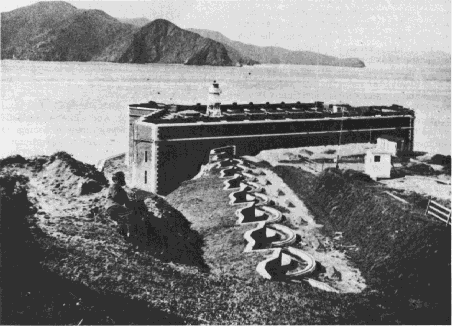
The parapets and breast-height walls of Battery East have survived
to a greater extent over the years. As far as it is known, no
mortars were ever mounted at either battery. East Battery had
five 15-inch Rodmans, and four 8-inch converted rifles mounted
in 1897. In 1996, little remains of the West Battery and most
of East Battery is still visible but covered with weeds and grass.
At Fort Point itself an inspection of
the existing armament was made by Colonel Barton S. Alexander,
Senior Engineer on the Pacific Coast, in April 1868. The following
wide variety of armament was reported as mounted and unmounted:
Type of Cannon
Quantity Mounted
Quantity Unmounted
8-inch Columbiads
8
10-inch Columbiads
2
42-pounder smoothbores
38
8
32-pounder smoothbores
11
24-pounder smoothbores
6
24-pounder Howitzers
4
10-inch siege mortars
2
24-pounder Coehorn mortars
5
15-inch Rodmans
25
10-inch Rodmans
40
300-pounder Parrott
rifles
2
200-pounder Parrott
rifles
6
8-pounder brass Spanish
cannon
4
10-inch siege guns
4
As is clear from this report, none of
the "modern" post Civil War guns were mounted in Fort
Point at this time. The Board of Engineers for the Pacific Coast
recommended that the armament at Fort Point be replaced with
10-inch Rodmans and 200-pounder Parrott Rifles.
Battery Fort
Point Report of Completed Works - Seacoast Fortifications