
A source of confusion in any discussion of the military posts of San Francisco Bay is Fort Winfield Scott. 'Defining exactly what and where it was is no simple matter., and there were two phases to the use of the term, But for the purpose of understanding what it meant there are two central facts: Fort Winfield Scott was physically a part of what is generally understood as the Presidio of San Francisco; and since 1910 it has comprised in part a geographically separate and architecturally distinct set of buildings around a separate parade ground most of them built in 1910. 1921 and 1912. The layout of the buildings was in the form of a hook or -backwards "J" with the top of the letter to the north.
The earliest usage of the name was somewhat different, The masonry and brick fort built in the 1850s on the site of the old Spanish Castillo de San Joaquin did not., for more than twenty years after acquiring its first garrison in 1861. have a formal military name. The point of land on which it was built had been called-by the Americans "Fort Point" because of the location there of the old Spanish castillo and., subsequently., the American fort which replaced it. But that was not the official name of the fort. It was referred to in official army documents as "the Fort at Fort Point.," but of course in common usage, the term "Fort Point" more often referred to the fortification itself than the point of land on which it stood,
Then on November 25, 1882, Headquarters of the Army issued General Orders No. 133 which officially named that fort at Fort Point., "Fort Winfield Scott.," after the general who was a hero of the Mexican War and who commanded the Union Army at the beginning of the Civil War. However., only four years later, the fort was downgraded to being a mere sub-post of the-Presidio of San Francisco with its none discontinued on September 15, 1886. In common usage, of course,, the name survived for many years more, although it had no administrative meaning.
Planning had been in progress in the 1890s as new types of breechloading long range guns were being emplaced around San Francisco Harbor for a garrison for the men to man those which were within the Presidio as well as a coast defense headquarters distinct from the Presidio. But this -was not actually constructed until 1909-1912, and when was finished the old name was resurrected, On June 18, 1912, in response -to instructions issued from the War Department in Washington on February 16, the Western Division published General Orders No. 11 which stated that "Fort Winfield Scott., California, is established as an independent coast artillery post, to take effect at 12 o'clock noon., June 19, 1912, and the headquarters of the Artillery District of San Francisco will be located thereat." Thus Fort Winfield Scott was a coast artillery garrison which comprised roughly the northwestern quarter of the land in the boundaries of the Presidio of San Francisco., and had responsibility for all the seacoast defense batteries , torpedo or mine facilities., and other supporting structures elsewhere in the Presidio, but principally along its northern and western edges. Defining the actual boundary of Fort Winfield Scott is virtually impossible as it seems never to have been consistently specified. The one and only true "entrance" to Fort Winfield Scott consists of lettering spelling out that name, flanked by the crossed-cannon-with-shell insignia of the Coast Artillery Corps, which are on the east side of the Highway 1 overpass over Kobbe Avenue (see photograph above.)
The key buildings of the new post were Mission Revival style barracks and other structures around the Parade Ground. The first built were buildings 1206, 1207 and 1208, reinforced concrete barracks with mess halls and kitchens included built in 1910 at the northwest corner of the Parade Ground. In 1911, two more of these were added., Buildings 1202 and 1203. In 1912 the largest amount of construction took place: Post Headquarters No. 1201, five more barracks with mess halls and kitchens included (1204, 1205, 1216, 1217 and 1218), a Band Barracks (1214), a Guardhouse(No. 1213) at the northeast corner of the Parade Ground, and the unlikely combination of a Quartermaster Storehouse and Bowling Alley (No. 1219), This comprised the basic Fort Winfield Scott artillery garrison complex.
Another complex of officers' quarters was absorbed into the new artillery post. These were the stately officers' quarters on Kobbe Avenue. The earliest of these, Nos. 1302 and 1304, were built in 1902. Then in 1910 three were added (1300, 1308 and 1310) and in 1912 seven more (1314, 1320, 1322, 1324, 1326, 1328 and 1334). A Bachelor Officers' Quarters with Mess (1330) was added in 1915, A general's residence across the street was erected in 1915 (1337) and another in 1943 (1332) to the southeast. Other buildings were added in later years.
Although always physically a part of the Presidio of San Francisco, Fort Winfield Scott functioned sometimes as a separate military command partially dependent on the Presidio for logistic support., sometimes as a sub-post of the Presidio itself'. answerable to the Presidio commander. On November 27, 1922 it was designated headquarters for the "Coast Defenses of San Francisco," but on June 9, 1925, that term was changed to "Harbor Defenses of San Francisco." As headquarters for that function., Fort Winfield Scott had at different times a number of sub-posts of its awn in the Bay Area: these included Forts Baker., Barry and Cronkhite in Marin County and Forts Miley and Funston in San Francisco. Neither the Presidio of San Francisco nor Fort Mason were ever sub-posts of Fort Scott, although both had some guns and other ancillary facilities (searchlights fire control stations, torpedo or mine facilities, etc.) that did come under Fort Winfield Scott's command.
Fort Winfield Scott's independent role., established in 1912, seems to have permanently ended on June 25, 1946, when it was designated a sub-post of the Presidio of San Francisco.. Although it was reclassified under the Commanding General of the Sixth Army on September 25, 1946.
Fort Scott had one other significance in history, On June 1, 1946, the army's Coast Artillery School was transferred from Fort Monroe., Virginia,, to Fort Winfield Scott., where it operated for a brief period before coast artillery defenses became obsolete when confronted with modern air power guided missiles,, and nuclear weapons., which of course made Fort Scott's own mission obsolete. Since then., Fort Winfield Scott's barracks have served other purposes., and in 1981 house the 504th Military Police Battalion.
Originally Published in 1981 for the annual meeting of the Council on Abandoned Military Posts. Reprinted with permission of the author

A source of confusion in any discussion of the military posts of San Francisco Bay is Fort Winfield Scott. Defining exactly what and where it was is no simple matter, and there were two phases in the use of the term. But for the purpose of understanding what it meant there are two central facts: Fort Winfield Scott was physically a part of what is generally understood as the Presidio of San Francisco and since 1910 it has comprised in part a geographically separate and architecturally distinct set of buildings around a separate parade ground, most of them built in 1910, 1911, and 1912. The layout of the buildings was in the form of a hook or backwards "J" with the top of the letter to the north.
The earliest usage of the name was somewhat different. The masonry and brick fort built in the 1850s on the site of the old Spanish Castillo de San Joaquin did not, for more than twenty years after acquiring its first garrison in 1861, have a formal military name. The point of land on which it was built had been called by the Americans "Fort Point" because of the location there of the old Spanish Castillo and, subsequently, the American Fort, which replaced it. But that was not the official name of the Fort. It was referred to in official Army documents as "the Fort at Fort Point," but of course in common usage, the term "Fort Point" more often referred to the fortification itself than the point of land on which it stood.
Then on November 25, 1882, Headquarters of the Army issued General Orders No. 133 which officially named that Fort at Fort Point, "Fort Winfield Scott," after the general who was a hero of the Mexican War and who commanded the Union Army at the beginning of the Civil War. However, only four years later, the Fort was downgraded to being a mere sub-post of the Presidio of San Francisco with its name discontinued on September 15, 1886. In common usage, of course, the name survived for many years more, although it had no administrative meaning.
Planning had been in progress in the 1890s for a garrison for the men to man the new types of breech loading long-range guns that were being emplaced around San Francisco Harbor. They were to man the guns, which were within the Presidio. A coast district defense headquarters district for the Presidio was also planned. But this was not actually constructed until 1909-1912 and when it was finished the old name was resurrected. On June 18, 1912, in response to instructions issued from the War Department in Washington on February 16, the Western Division published General Orders No. 11, which stated that "Fort Winfield Scott, California is established as an independent coast artillery post, to take effect at 12 o'clock noon, June 19, 1912, and the headquarters of the artillery District of San Francisco will be located there at." Thus Fort Winfield Scott was a coast artillery garrison, which comprised roughly the northwestern quarter of the land in the boundaries of the Presidio of San Francisco. It had responsibility for all the seacoast defense batteries, torpedo and mine facilities, and other supporting structures elsewhere in the Presidio, but principally along its northern and western edges. Defining the actual boundary of Fort Winfield Scott is virtually impossible, as it seems never to have been consistently specified. The one and only true "entrance" to Fort Winfield Scott consisted of lettering spelling out that name, flanked by the crossed-cannon-with shell insignia of the Coast Artillery Corps, which are on the east side of the Highway 1 overpass over Kobbe Avenue in the Presidio. While the formal name was not assigned until 1912, as part of the historic Presidio, this Fort can be considered the oldest Fort in the Bay area. The key buildings of the new post were Mission-revival style barracks and other structures around the parade ground. The first, built in 1910, were reinforced concrete barracks with mess halls and kitchens included, at the northwest corner of the Parade Ground. In 1911, two more of these were added. In 1912, the largest amount of construction took place. These were Post Headquarters, five more barracks with mess halls and kitchens included, a Band Barracks, a Guardhouse at the northeast corner of the Parade Ground, and the unlikely combination of a Quartermaster storehouse and Bowling Alley. This comprised the basics for the Winfield Scott Artillery garrison complex. While later in history, this complex sounds very much like the buildings found in the "Horse Soldier" forts in the early California wilderness, except for the bowling alley and modern construction.
Another complex of officers' quarters was absorbed into the new artillery post. These were the stately officers' quarters on Kobbe Avenue. The earliest of these were built in 1902. Then in 1910 three were added and in 1912, seven more. A Bachelor Officers' Quarters with Mess was added in 1915. A general's residence across the street was erected in 1915 and another in 1943 to the southeast. Other buildings were added in later years.
Although always physically a part of the Presidio of San Francisco, Fort Winfield Scott functioned sometimes as a separate military command partially dependent on the Presidio for logistic support and sometimes as a sub-post of the Presidio itself, answerable to the Presidio commander. On November 27, 1922 it was designated Headquarters for the "Coast Defense of San Francisco," but on June 9, 1925 that term was changed to "Harbor Defense of San Francisco." As headquarters for that function, Fort Winfield Scott had at different times a number of sub-posts of its own in the Bay Area, i.e. most of the forts to be described in the following sections. Neither the Presidio of San Francisco nor Fort Mason were ever sub-posts of Fort Winfield Scott, although both had some guns and other ancillary facilities that did come under Fort Winfield Scott's command.
Fort Winfield Scott's independent role, established in 1912, seems to have ended permanently on June 25, 1946, when it was designated a sub-post of the Presidio, although it was reclassified under the Commanding General of the Sixth Army on September 25, 1946.
Fort Scott had one other significance in history. On June 1, 1946, the Army's Coast Artillery School was transferred from Fort Monroe, Virginia, to Fort Winfield Scott, where it operated for a brief period before coast artillery defenses became obsolete when confronted with modern warfare weapons.
In 1981, the Fort Winfield Scott barracks housed the 504th Military Police Battalion.
Fort Winfield Scott Defenses
Fort Winfield Scott had seven defense areas. The oldest were Fort Point and Batteries East and West. These have been well discussed in foregoing sections. The early Endicott-type batteries on the west facing cliffs and the in-bay batteries were the first new batteries. Additional batteries were added to the south along the bluffs along with two 12-inch mortar batteries. Then came the mine and torpedo facilities, antiaircraft batteries and finally the new age missile batteries in the 1950s were added.
The defenses of San Francisco were nationally
second in priority only to New York Harbor. There were seventeen
new facilities added to the defense of the Bay area at Fort Winfield
Scott. These will be discussed in the following sections.
Endicott Batteries on the Northwest Bluffs
Beginning at the Golden Gate Bridge Toll Plaza and extending southward along the bluffs at the northwestern edge of the Presidio of San Francisco are five post-Endicott Board (1885) seacoast defense batteries. They include some of the earliest Endicott- type artillery defenses of San Francisco Bay. When begun, and for some time after completion, these batteries remained unnamed and during construction were known simply by emplacement numbers assigned by the New York Board of Engineers in preparing the first Endicott-type plans for San Francisco Bay in 1890. These batteries were:
The In-Bay Batteries
Four batteries were built during the Endicott period that provided a rapid field of fire in the bay east of the Golden Gate. These were located on the bluffs about 50 feet above the water and about a quarter mile back from the waters edge. Their purpose was to protect the minefields and to stop any enemy high-speed boats from entering the Bay.
Batteries On the Bluffs South of the Early Endicott Batteries.
Mortar Batteries
Other Batteries
Fire Control Stations
Several artillery fire control stations remain at Fort Winfield Scott. At the tip of the bluff at Fort Point, west of the approach to the Golden Gate Bridge, are four or five dug-in reinforced concrete structures partially camouflaged by earth and rock. They appear to date from before World War II but saw service in that war. In the post war plans two were retained, one for Battery Lowell Chamberlin and one for Mines II.
Elsewhere a large, two-room, concrete fire control station stands just off Washington Boulevard and adjacent to the West Coast Memorial. Before World War II it served as the harbor defense station but its wartime role remains unknown. The walls are partly protected by earthen embankments but the structure does not now possess any overhead protection.
Another large, two-room, concrete fire control station stands south of Battery Godfrey.
Due to the high cliffs at San Francisco, fire control stations were usually dug-in affairs and towers were not required as they often were on the east coast. However, a concrete, two-story tower was built on the left flank of Battery Lancaster for signaling purposes with defenses on the Marin Headlands.
Report of Completed Works - Seacoast Fortifications: Fire Control Stations and Associated Structures
Submarine Mine Depot
Controlled, electrically fired submarine mines originally called torpedoes, were introduced to San Francisco harbor defenses in 1883. Mines were an American invention.
Mines were stored in secure buildings until needed to protect the harbor during a military emergency. They were then set out in grids covering hundreds of acres on the bottom of the bay or coast by a fleet of boats and personnel dedicated to this mission. Each mine was connected by a cable to a junction box and the box connected by cable to a control panel at a fire control station on shore. If an enemy ship or submarine were to venture over the mines, Army personnel at the fire control stations would set them off. Rapid-fire guns were placed along the shore to protect the mines from being blown up by enemy forces before an invasion of landing craft. Later, with the advent of electricity, searchlights were placed near the minefields so that they could be illuminated at night for further protection.
Since it was the Corps of Engineers that pioneered the development of the torpedo defense systems, responsibility for their installation and management remained for some years with the engineers. In 1903, however, the responsibility was transferred to the Coast Artillery Corps and it was not until 1949 that responsibility for harbor defense minefields was transferred to the U.S. Navy, only one year before the Coast Artillery Corps was disbanded, as air power made it obsolete.
It was in June 1883 that the first shipment of "buoyant torpedoes" arrived in San Francisco. They were temporarily stored in the pier casemate at Alcatraz, until a concrete torpedo storehouse could be planned and built on the northern end of Yerba Buena Island. This was completed in 1889. This original storehouse still stands beneath the North approach of the Bay Bridge.
Electrically fired "torpedoes" or mines required a control room from which cables ran up into the water and from which an operator sent the electrical impulse to fire the mine. These were termed mine or torpedo casemates. In 1889 funding was provided to construct the first two of these in San Francisco Bay, one on Alcatraz and one at Fort Mason. The Alcatraz casemate was simply an adaptation of part of an existing structure at the bombproof barracks there, but an entirely new Fort Mason torpedo casemate was built in 1890 and still exists.
Mines were not placed until the stimulus of the Spanish American War, when 28 harbors nationwide were mined. San Francisco was the only port mined on the west coast. Its first mine was planted on June 11, 1898, and mine planting continued until July 16, when 63 had been emplaced. However, the armistice with Spain of August 12 resulted in the subsequent pick up of the mines, which were cleaned and again stored in the Yerba Buena storehouse by November 1898.
To plant the mines, the Army used tugboats,
lighters and other small craft until April 16, 1909, when two
of the Army's first class of especially designed mine planters,
the Armistead and the Ringgold, steamed through the Golden Gate.
In the 1930s and 40s the Niles and the
El Aquario took their place along with a few yawls and L-boats
used to plant cables and junction boxes.
Meanwhile, new mining casemates were built and some old ones abandoned. One was added north of Point Cavallo and a fourth near Mortar Hill on Angel Island. In March 31, 1903 the responsibility for mines in San Francisco Bay transferred from the Corps of Engineers to the Coast Artillery Corps. The artillery command relocated the mine depot at Yerba Buena Island further west to a new depot and wharf built between 1907 and 1910, a short distance east of Fort Point. Although poorly located and designed this depot served through World Wars II and I. Most of the buildings still stand. New mine casemates were built, one at Fort Barry in 1908, one at Fort Baker in 1909 and one at Baker Beach in Fort Winfield Scott in 1912. A new mine depot and casemate, which supplemented that at Fort Point, was begun in 1937 at Fort Baker and completed in 1941. A new mine casemate at Baker Beach was built in 1943.
Fields of both shore-controlled mines and some contact mines were planted outside San Francisco Harbor during the late 1930s and early 1940s. By the end of the war in 1945, the harbor was protected by 37 mine groups with 13 mines in each group for a total of 481 mines.
Minefields were also built at San Diego and San Pedro.
Observation stations kept watch on the minefields around the clock. Plotting boards were used to keep track of every mine in the field. While Batteries A and F of the 6th Coast Artillery planted, maintained, and operated the mine defenses, the Mine Flotilla, comprised of detachments from both batteries, cared for and manned the L-boats and mine yawls. The two batteries and the flotilla formed the HDSF Mine Battalion. The mine planter ships worked with the Battalion, but were independent units under the harbor defense command. Above battalion level came the Mine Groupment that grouped the minefields under covering fire of 6-inch gun batteries. One group consisted of mines in northern waters, covered by 3-inch, 6-inch and 155 mm gun batteries around Rodeo Beach. Two 6-inch batteries at Fort Scott and a battery of 155 mm guns at Kirby Cove protected another mine group in the Main Channel. The southern fields extending from Ocean Beach were guarded by 6-inch guns on the eastern heights of Fort Barry. The Mine Groupment also controlled 3-inch guns at Fort Baker, which covered the Navy's submarine net. At Fort Barry on Bonita Ridge stood the Mine Groupment Command Post. The station had telephones to all batteries of the groupment, a direct intelligence line to the hydro-acoustic listening post at Fort Miley, and Sutro's Baths; and for observations, a Lewis Depression Range Finder. An officer and three enlisted men manned the command post at all times. From here nighttime operations were conducted to determine the status and efficiency of the system. Searchlights were commanded on and off while gun batteries were given test-firing instructions. The results of these activities were reviewed along with the status of the minefields as reported on the plotting boards to determine the readiness of the whole system.
Fort Winfield Scott received the first mine facility near Fort Point to cover the entrance to the Golden Gate. A second facility was placed at Baker Beach to cover the coastal approaches to the Golden Gate.
The Army Coast Artillery Corps mine depot at Fort Point was constructed between 1907 and 1910. It consisted of a wharf, a tramway leading from the buildings to the wharf, a cable tank building, a mine storehouse, two loading rooms, and two explosives rooms. Of these original buildings only the cable tank has been demolished. The wharf was rebuilt in 1941 to accommodate the new mine planter vessels. The mine storehouse stored all the material for eleven groups of mines. The loading rooms have become National Park Service maintenance facilities.
Two casemated buildings were located at Baker Beach overlooking the Pacific Ocean to send signals to explode submarine mines planted outside the Golden Gate. Casemate 1, a concrete structure built in 1912, measured 24 feet by 56 feet. It stood 200 feet inland from high tide and earthen embankment hid it from the sea. In World War I the structure was strengthened by the addition of concrete over the roof and the walls. It served in the harbor defenses until 1943, when the larger Casemate II replaced it.
Mining Casemate II, situated a little further inland in 1943 was a double casemate that contained the equipment to operate two minefields - Mines II in the Main Channel, and Mines III in the South Channel. It retains some of its original equipment including control panels and equipment for removing poison gases from the air and contaminated personnel.
Report of Completed Works - Seacoast Fortifications: Mine Casemates and Associated Structures
Permanent Seacoast Searchlights
Report of Completed Works - Seacoast Fortifications: Seachlights
Air Defense Missile Battery
San Francisco Defense Area Site SF-89L, unofficially known as Battery Caulfield, was a 1950s Nike-Ajax air defense missile battery, was located southeast of Battery Chamberlin. It was disarmed in the 1960s but most of its original structures still existed in 1995. The Intigrated Fire Control Area, SF-89C, was located on Mount Sutro
References: Seacoast Fortifications, San Francisco Harbor by Erwin N. Thompson 1979; Special History Study, Presidio of San Francisco by Erwin N. Thompson 1992; Fort Winfield Scott by Gordon Chappell and Charles Hawkins, circa 1980; Early Endicott Batteries Guarding San Francisco Bay by Gordon Chappell 1981; Forts Under the Sea by Gordon Chappell 1981; Artillery at the Golden Gate by Brian B. Chin 1994; National Archives, San Bruno, California; Army Presidio Museum Archives.

Batteries at Fort Winfield Scott
|
|
|
|
|
|
|
|
|
|
|
|
|
|
|
|
|
|
|
|
|
|
|
|
|
|
|
|
|
|
|
|
|
|
|
|
|
|
|
|
|
|
|
|
|
|
|
|
|
|
|
|
|
|
|
|
|
|
|
|
|
|
|
|
|
|
|
|
|
|
|
|
|
|
|
|
|
|
|
|
|
|
|
|
|
|
|
|
|
|
|
|
|
|
|
|
|
|
|
|
|
|
|
|
|
|
|
|
|
|
|
|
|
|
|
|
|
|
|
|
|
|
|
|
|
|
|
|
|
|
|
|
|
|
|
|
|
|
|
|
|
|
|
|
|
|
|
|
|
|
|
|
|
|
|
|
|
|
|
|
|
|
|
|
|
|
|
|
|
|
|
|
|
|
|
|
|
|
|
|
|
|
|


SCR-296 Fixed Coast Artillery Gun-Laying Medium Wave Radar Set No. 7
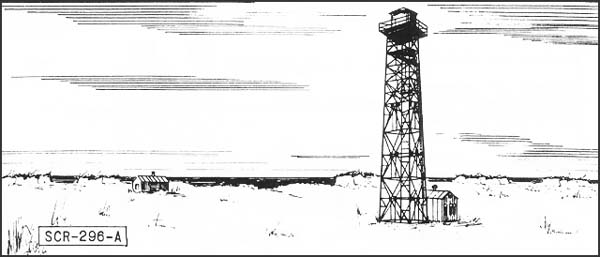
Description: Fixed Coast Artillery gun-laying medium wave radar, assigned to modern 6 inch or larger batteries.
Uses: Set is designed to track a surface target in range and azimuth. Data are sent to the plotting room and used in firing. An SCR-296-A normally is assigned to one battery, but may furnish data to more. Works with IFF RC-136-A.
Performance & Sitting: Range is shown on "A" scope. The target is tracked in azimuth with a pip matching oscilloscope or a zero-center meter. Range accuracy is about ± 30 yards while azimuth accuracy is about ± 0.20 degree under the best conditions. The set has a dependable range of 20,000 yards on a destroyer size target when employed at a height of 145 feet. Site should be not less than 100 feet above sea level; 150 to 500 feet is recommended.
Mobility: Shipment includes areas and separate generator. When crated the total weight is 91,763 lbs. Largest unit is 5,270 lbs.
Installation: SCR-296-A includes a tower, an operating building, and two power plant buildings. The tower is obtainable in heights of 25, 50, 75, and 100 feet. Concrete floors must be put in locally.
Personnel: Operating crew consists of 5 men in addition to a power plant operator and maintenance man who should be available at all times.
Power: Primary power of 2.3 KW is supplied by PE-84C -- commercial or auxiliary 110 V, AC single phase. Generator needs high octane gasoline.
|
World War I |
|
| US Army Order of Battle 1919-1941 | 1919 |
|
| US Army Order of Battle 1919-1941 | 1919-1941 |
|
| US Army Order of Battle 1919-1941 | 1919-1922 |
|
| US Army Order of Battle 1919-1941 | 1921-1930 |
|
| US Army Order of Battle 1919-1941 | 1921-1941 |
|
| US Army Order of Battle 1919-1941 | 1922-1924 |
|
| US Army Order of Battle 1919-1941 | 1933-1941 |
|
| US Army Order of Battle 1919-1941 | 1938-1941 |
|
| US Army Order of Battle 1919-1941 | 1940-1941 |
|
| 7 December 1941 |
|