California State Military
Department
- The California
State Military Museum
- Preserving California's
Military Heritage
- Historic California Posts
- Fort Rosecrans
- (Including Castillo de Guijarros
and Point Loma Military Reservation)
- By George Ruhlen
(Colonel, United States Army, Retired)
-
- The southern end of Pt. Loma was set aside
as a military reservation by Executive Order of the President
of the United States on Feb. 26, 1852; its northern boundary
was a line from the harbor to the ocean at a distance of 11/2
miles north of La Punta de los Guijarros, which we now call Ballast
Point.
-
- Two small tracts later were set aside
for lighthouse purposes, one at Ballast Point and one at the
tip of the reservation, and a third was reserved for the Quarantine
Station, near La Playa. On Sept. 24, 1901, the northerly part
was transferred to the Navy for a coaling station. The reservation
was first used for military purposes by the United States on
Feb. 28, 1870, although it previously had been so used by both
the Spaniards and Mexicans.
-
- By general acts of the California Legislature
on Mar. 2 and 9, 1897, the state ceded to the United States exclusive
jurisdiction on all lands held for military purposes, including
the parcels of land from high-water mark to 300 yards beyond
low-water mark, lying adjacent to shore-side military reservations.
The state reserved the right to serve civil Processes not incompatible
with this cessation, and such criminal processes as may lawfully
issue against persons charged with crimes committed outside of
such lands.
-
- As early as 1792, the Spanish authorities
realized the defenseless condition of their California ports,
and issued orders to take all steps to keep foreigners from becoming
cognizant of the fact. The matter was brought home forcibly by
Captain George Vancouver of the British Royal Navy, who called
here in 1793 and concluded some unfavorable observations about
their Presidio by the remark that "With little difficulty
it might be rendered a place of considerable strength, by establishing
a small force at the entrance of the port; where at this time
there are neither works, guns, houses or other habitations nearer
than the Presidio, five miles from the port and where they have
only three small pieces of brass cannon."
-
- Thus aroused by the Britisher, and somewhat
perturbed by encroachments of the Russians in the north, they
projected a fort at Punta de los Guijarros. Workmen and materials
were sent from Monterey and Santa Barbara while brick and tile
were hauled from the Presidio to the beach and taken across to
the point by flatboat. In 1797 the engineer, Capt. Alberto de
Cordoba, advised changing from the proposed circular fort at
the end of the point to an adobe fort with two wings mounting
ten guns, sited near the shore end. The fort was built on ground
later to be occupied by Fort Rosecrans' Battery Fetterman, of
two 3-inch seacoast guns. This battery has been razed and a storehouse
erected on the site.
-
- Castillo Guijarros
- by Jay Wegter, 1990
- Image courtesy of
the Fort Guijarros Museum Foundation
-
- Fort Guijarros' baptism of fire occurred
Mar. 22, 1803. The Yankee brig Lelia Byrd, after some contraband
dealings with the inhabitants, was seized and put under armed
guard. Overpowering the Spaniards, the crew raised anchor and
stood out to sea, carrying the guard with her. The fort opened
fire, scoring several hits. Abeam of Ballast Point, the brig
fired a broadside from her six 3-pounders, driving the defenders
from their batteries. Once out of range, the Yankees put the
terrified guards (who had been forced to line the rail during
the engagement) into a boat and let them row ashore.
- Time passed. The fort fell into disuse
and disrepair; by 1839 only two serviceable cannon were left.
Early in 1840 the remnants of the fort and casa mata were sold
to Juan Machado for $40. One of the guns now is mounted on a
pedestal in the Old Town Plaza, another is at the site of Fort
Stockton on Presidio Hill. The rest are gone. One story is that
they were spiked by an American sea-captain in 1842 and thrown
into the bay, another is that they were moved to Los Angeles
or Santa Barbara. Some of the tiles went into the "Old Spanish
Lighthouse" built on top of Point Loma by the Americans
in 1855.
-
- It was not until May of 1873 that work
began on earthen seacoast batteries for fifteen guns of the largest
caliber, to protect the harbor of San Diego. The work continued
through the following year and considerable progress was made
when the funds gave out and work stopped. Faces of the batteries
had been raised to parade level and one magazine was partially
built. Things remained in this unfinished, utterly worthless
state for twenty years, as Congress made no appropriations for
seacoast defense from 1875 to 1890. In 1885 President Cleveland,
by direction of Congress, appointed a board of distinguished
Army and Navy officers and civilians to "examine and report
at what ports fortifications or other defenses are most urgently
required." San Diego was one of the ports listed.
-
- Construction of emplacements for two 10-inch
seacoast guns on disappearing carriages began at Ballast Point
in January of 1897 and continued for several years. A third emplacement
was completed Feb. 7, 1898; the guns were mounted by artillery
troops of the garrison between Apr. 9 and May 21 the same year.
-
The
submarine mining casemate was finished about this time. The Engineer
Corps in those days was charged with submarine mine operations,
and the engineer officer in charge of construction, Capt. J.
J. Meyler, organized a volunteer company of citizens to plant
and operate the mine-field. There were about 80 men - carpenters,
electricians, civil engineers, surveyors, telegraphers, boiler-makers,
steam engineers, boatmen, mechanics, and a few soldiers from
the local Engineer Battalion. On May 23 and 24 they planted fifteen
electrically-controlled mines in the channel, an open passage
marked by buoys being left. The minefield was protected by two
smooth-bore muzzle-loaders of Civil War vintage and patrolled
by the Revenue Cutter Corwin. The two guns now ornament the headquarters
building at the fort; in September 1898 the mines were taken
up, cleaned and stored.
-
- It was appropriate that Battery D, 3rd
Artillery, was the first to occupy the new fort, for Battery
D had been the last military unit to occupy the San Diego Mission,
then a military post. That was back in 1858, when the battery
was ordered into Washington Territory to fight Indians. Now,
forty years later, a detachment of twenty soldiers from the same
old battery arrived from San Diego Barracks, under 2nd Lt. George
T. Patterson. That was on Feb. 2, 1898; on Feb. 15 Capt. Charles
Humphreys and the rest of the battery arrived. In July 1900 the
battery was ordered to China and saw action in the Boxer Uprising.
Duty in the Philippines and in France during World War I intervened
before the battery returned to Fort Rosecrans, on July 1, 1924.
-
- The fourth emplacement for the 10-inch
gun battery was completed Feb. 13, 1900. Originally called Battery
Wilkinson, it later was divided into two batteries; the left
pair kept the same name, and the right pair was named Battery
Calef. At the same time Battery Fetterman of two 3-inch guns,
and Battery McGrath of two 5-inch, were built. The buildings
were erected from 1901 to 1904 and are frame construction except
for the Post Exchange, where post headquarters is now located,
which is brick.
-
- The fort was named for Maj. Gen. William
Starke Rosecrans, U.S.V. (Brigadier General, U.S.A.). He graduated
from the U.S. Military Academy July 1, 1842, was commissioned
Bvt. 2nd Lt., Corps of Engineers, and resigned April 1, 1854.
He went back, served with distinction in the Civil War and resigned
Mar. 28, 1867; appointed Brigadier General Feb. 27, 1889, retired
March 1 and died March 11, 1898. He visited San Diego in 1871
in the interests of the Texas & Pacific Railroad and is purported
to have offered Alonzo Horton $250,000 for New San Diego.
-
- On Aug. 20, 1901, the 115th Company of
Coast Artillery was organized at San Diego Barracks and then
transferred to Fort Rosecrans, where it remained until July 1,
1924, when it was sent to Puget Sound. On the same date the 28th
Company of Coast Artillery (formerly Battery E of the Third Artillery)
was transferred to the Columbia River, having served at Rosecrans
from July 2 5, 1905.
-
- Service at Fort Rosecrans was considered
highly desirable, and applications for transfer or re-enlistment
of discharged soldiers into its companies were being received
constantly. As a result, the garrison was maintained at full
strength with capable and experienced soldiers. It was jokingly
called an "old soldiers' home" and many of those who
served there, when discharged or retired from the service, became
substantial citizens of San Diego and the surrounding community.
-
- From 1911 to the outbreak of World War
I the garrison was active in patrolling the Mexican border, housing
and guarding interned military prisoners captured at the border
while fleeing from Mexico, and assisting in the training of the
California National Guard.
-
- Two 12-inch mortar batteries (Whistler
and White) were constructed in 1915-16, White in a ravine just
west of the post and Whistler in a ravine on the bay side of
the peninsula ridge, a short distance south of the gate on the
upper road.
-
- During World War I, in addition to its
own complete garrison, the 1st Battalion of the 65th Coast Artillery,
the 54th Ammunition Train and the 1st and 2nd Antiaircraft Batteries
were organized and trained at Rosecrans, and dispatched overseas.
In 1922, the Coast Artillery did not have enough men to fully
garrison all of its stations in the United States and also maintain
the overseas garrisons at sufficient strength; the latter task
took almost half of the manpower of that arm. Consequently some
of the home forts went on caretaker status, Fort Rosecrans among
them.
-
- Fort Pio Pico, a sub-post of Fort Rosecrans,
was built on North Island opposite Ballast Point, in 1906. It
was abandoned in 1919 and its two 3-inch guns were installed
in Battery McGrath, whose 5-inch guns had been sent overseas.
-
- While it was in caretaker status, Fort
Rosecrans, on two occasions, provided quarters for troops other
than artillery. In 1930, it became headquarters for the Sixth
Infantry Brigade, commanded by Brig. Gen. Ralph H. VanDeman,
who moved his headquarters here from the interior. A troop of
the 11th Cavalry was stationed at Fort Rosecrans from October
1931, following the abandonment of Camp Hearn at Imperial Beach.
In August 1932 they moved on to Monterey.
-
- Impending war in 1941 resulted in strengthening
the defenses of San Diego. The 1917 cantonment buildings had
been razed, and now new buildings took their place; some were
close to the post and others were on the upper part of the reservation.
The latter ones later were turned over to the Navy and became
part of the Naval Electronics Laboratory. Battery Strong's emplacement,
on the ocean side of the point near the upper gate, was finished
in 1937, and its two 8-inch guns on barbette carriages were mounted
in April 194 1. A 6-inch battery -- Humphreys -- was situated
on the bay side, near the tip of the point.
-
- Battery Ashburn, two 16-inch guns in casemates,
was completed Aug. 26, 1943, on the seaward side just north of
the Old Lighthouse. Antiaircraft batteries, mobile batteries,
searchlights and fire-control installations were placed along
the coast from La Jolla to the Mexican border. In 1942 the 262nd
and in 1943 the 281st Coast Artillery Battalions were organized
and trained at the post and sent overseas, while other units
used the fort for special training.
-
- With the passing of the battleship and
its counterpart, seacoast artillery, Fort Rosecrans again has
been placed on a caretaker status and its armament scrapped.
On July 1, 1959, the reservation was transferred to the Navy
Department. However, the headquarters for Army Reserve components
in the San Diego area remain there.
-
- Several historical landmarks are within
the reservation, some accessible to the public and others in
restricted areas. The point always has been a mecca for tourists,
and in 1910 a road surfaced with decomposed granite was built
along the crest of the point, out to the Old Lighthouse. It was
sprinkled with salt water pumped up from the bay to a tank on
top of the point, and distributed to sprinkling-carts. It was
entirely satisfactory for the traffic of the period.
-
- A presidential proclamation on Oct. 14,
1913 set aside about half an acre surrounding the Old Lighthouse
as an historic landmark, and the site for a monument commemorating
the discovery of California by Cabrillo on Sept. 28, 1542. The
area recently has been increased to about 35 acres.
-
- Fort Rosecrans National Cemetery, on the
crest of the point, first was used as a burial-ground for San
Diego Barracks and was known as "Post Cemetery, San Diego
Barracks (Point Loma)". The first burial there was that
of Pvt. John T. Welch of Company 1, 8th Infantry, Oct. 5, 1879.
When the fort was established it became Fort Rosecrans Post Cemetery
and was so designated until 1935 when it became Fort Rosecrans
National Cemetery. Originally about one acre, it now is over
forty times that size. Inside the stone wall of the original
area lie the remains of the soldiers of the First Dragoons who
were killed at the Battle of San Pasqual, Dec. 6, 1846. A granite
boulder from the battlefield bears a bronze plaque with the names
of the soldiers, while nearby are the graves of the two company
commanders, Capt. Benjamin D. Moore and his brother-in-law, 2nd
Lt. Thomas C. Hammond, killed while leading the attack. Beside
is the grave of Bvt. Lt. Col. Louis S. Craig, 3rd Infantry, murdered
on the Colorado desert by two Army deserters whom he was trying
to persuade to return to their station; Fort Craig, N. M., a
famous frontier post, was named in his memory. Nearby is buried
Albert B. Smith, who spiked the Mexican guns at Old Town Presidio
and nailed the American flag to the flagpole in the Plaza, while
under fire by Mexican snipers. The tall granite obelisk marks
the last resting place of the many American sailors who died
in the boiler explosion aboard the U.S.S. Bennington in San Diego
harbor July 21, 1905.
-
- In early days whalers set up their try-pots
on the bay side of Ballast Point; the spot was marked in 1933
but since has been covered with sand from a dredging project.
Ballast Point is where Cabrillo landed in 1542, where the name
San Diego first was applied by Vizcaino in 1602, where the first
permanent settlers of California landed in April 1769, and the
first Pacific Coast beacon was established the same year. The
Quarantine Station was at La Playa, site of the hide houses of
the Mexican period; the area now is occupied by a part of the
Naval Electronics Laboratory.
-
- In a restricted area on the west side
of the point is what is left of a coal mine which was worked
in 1847 by soldiers of the Mormon Battalion. It was worked again
as late as 1891, when the Commanding Officer of the Barracks
was instructed to eject trespassers who were operating there
without authority.23 Other registered landmarks are Fort Rosecrans
itself and its predecessor Castillo Guijarros.
-
- Point Loma, rising clear and majestic
against the western sky, unfolds from its crest one of the most
magnificent panoramas in the world. The serene, curving bay,
flanked by the white-bordered Silver Strand and the rising terraces
of San Diego, is set out in the picture of the distant mountains
as a background. Standing at the Old Lighthouse, absorbed in
the beauty and splendor of nature's picture, one can well vision
it as it was when first seen by the explorers, and the words
of Winifred Davidson, San Diego's historian, come to mind:
-
- "It matters not greatly that the
world in general does not remember ... That the place where the
West began was the place wbere California began; and The place
where California bcgan was the promontory of Point Loma . . .
the sun-drenched, unspoiled acres where in California be whom
we incorrectly name Juan Cabrillo in 1542 first walked; where
in 1602 Sebastian Vizcaino built on smooth sands a temporary
house of prayer ... where unofficially and with insolence to
the government under whose laws its makers were living, the Stars
and Stripes, the American flag, first welcomed into California
ships from Yankeeland.... These and other beginnings take old
Loma out of the class of the accustomed and The expected. Its
history is actually world history."
-
-
- Extracted from the The
Journal of San Diego History, October 1959, Volume 5, Number
4
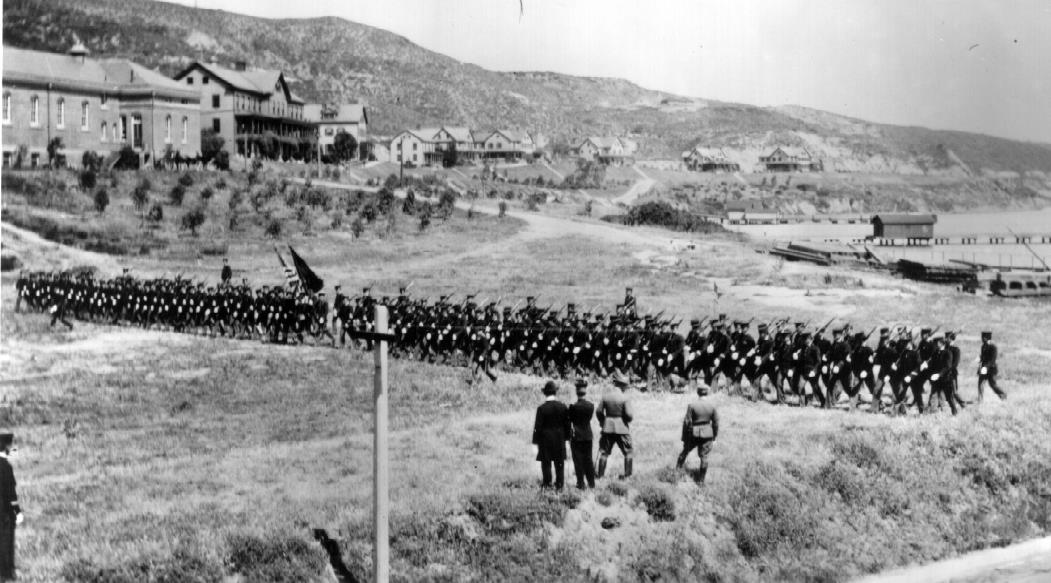
Fort Rosecrans,
Circa 1921

- Batteries
at Fort Rosecrans
-
- Spanish
Period
|
Location |
Battery name |
Number of Guns |
Type of Gun |
Constructed |
Completed |
Decommisioned |
|
Ballast Point |
Castillio de Guijarros |
10 |
Smoothbores |
1797 |
1799 |
183? |
-
- For all coastal defenses built in the
smoothbore era, (Spanish, American Third system and Post-Civil
War periods), the number of guns actually emplaced was usually
less than the number of emplacements built. Many of the cannons
were on hand and not emplaced and those numbers changed from
year to year. In addition, there often were several different
calibers of cannons present. The calibers of the Spanish era
cannons were given by the weight of the round shot fired by the
gun, i.e. a 42 pounder. The Americans had cannons of calibers
given both in pounds or inches of bore. These are not delineated
in the table as those of later years are.
-
- Post
Civil War Period
|
Location |
Battery name |
Number of Guns |
Type of Gun |
Constructed |
Completed |
| Point Loma |
None |
15 |
15 inch Smoothbores |
1870 |
Not Completed |
Endicott Period
|
Location |
Battery name |
Number of Guns |
Type of Gun |
Type of Carriage |
Constructed |
Completed |
Decommisioned |
|
Fort Rosecrans |
- Wilkeson
|
1 |
10 Inch M1895 |
M1896 Disappearing | |
1900 |
1943 |
|
Fort Rosecrans |
Wilkeson |
1 |
10 Inch M1888MI |
M1896 Disappearing | |
1900 |
1943 |
|
Fort Rosecrans |
Calef |
2 |
10 Inch M1888MI |
M1896MI Disappearing | |
1900 |
1943 |
|
Fort Rosecrans |
McGrath |
2 |
5 Inch M1897 |
M1896 Ballanced Pillar | |
1900 |
1943 (1) |
|
Fort Rosecrans |
Fetterman |
2 |
3 Inch M1898 |
M1898 Masking Pedestal | |
1900 |
1943 (2) |
- (1) Battery McGrath's guns were removed
in 1917. In 1919 the guns of Battery Meed at Fort Pio Pico were
transfered to Battery McGrath.
- (2) The concrete emplacement of Battery
Fetterman was destroyed in July 1940.
- Taft
Period
|
Location |
Battery name |
Number of Guns |
Type of Gun |
Type of Carriage |
Constructed |
Completed |
Decommisioned |
|
Fort Rosecrans |
- Whistler
|
4 |
12 Inch M1890MI |
M1896MI Mortar |
1914 |
1916 |
1942 |
|
Fort Rosecrans |
White |
4 |
12 Inch M1890MI |
M1896MI Mortar |
1914 |
1916 |
1942 |
- Four of these mortars were from Fort DeSoto,
Florida, and 4 were from Fort DuPont, Delaware. Battery Whistler
is now substantially altered to a underwater testing tank facility.
The breeches for a 12" and a 16" naval gun are also
inside.
-
- World
War II Temporary
|
Location |
Battery name |
Number of Guns |
Type of Gun |
Type of Carriage |
Constructed |
Completed |
Decommisioned |
|
Fort Rosecrans |
- Zeilin
|
2 |
7 inch Naval |
Pedestal |
1937 |
1937 |
1943 (1) |
|
Fort Rosecrans |
Gillespie |
3 |
5 inch Naval |
Pedestal |
1937 |
1937 |
1943 (1) |
| Fort Rosecrans |
North |
4 |
155mm |
Panama Mount |
1942 |
1942 |
1943 (2) |
(1) These were temporary constructions, no trace remains at the
site.
(2) North Battery guns transfered to Battery Imperial in 1943?
- 1940
Program
|
Location |
Battery name |
Number of Guns |
Type of Gun |
Type of Carriage |
Constructed |
Completed |
Decommisioned |
|
Fort Rosecrans |
- Fredrick S. Strong
|
2 |
8 inch MarkVI M3A2 |
Long Range Barbette, M1 |
1938 |
1941 |
1946 |
|
Fort Rosecrans |
Thomas Q. Ashburn |
2 |
16 inch MarkIIMI |
Casemated Long Range Barbette
M1919M4 |
1942 |
1943 |
1948 |
| Fort Rosecrans |
237 (1) |
2 |
6 inch M1903A2 |
Shielded Long Range Barbette
M1 |
1942 |
1943 |
194? |
|
Fort Rosecrans |
Charles Humphreys |
4 |
6 inch M1903A2 |
Shielded Long Range Barbette
M1 |
1942 |
1943 |
194? |
-
- (1) Battery Contructions 239 and 134 were
unofficially named Charles G. Woodward and Gatchell respectively.
- [WELCOME] [LOCATION AND HOURS]
[CURRENT EXHIBITS] [MG WALTER P. STORY LIBRARY] [SATELLITE AND PARTNER MUSEUMS]
- [HOW CAN I HELP?] [WHAT'S NEW?] [UPCOMING EVENTS] [CALIFORNIA
MILITARY HISTORY] [ONLINE
BOOKSTORE]
- [CALIFORNIA
CENTER FOR MILITARY HISTORY]
[LINKS]

FastCounter by LinkExchange
Questions and comments concerning this site should
be directed to the Webmaster